How to Implement Military-Grade Data Destruction in Your Organization

As global data security threats intensify, organizations are increasingly turning to military-grade data destruction protocols to safeguard their sensitive information. High-level data destruction processes, typically reserved for national defense and intelligence agencies, are now finding relevance across industries where the stakes for data breaches are extraordinarily high. Whether protecting proprietary technology, national secrets, or critical infrastructure, implementing multi-layered data destruction protocols ensures that even the most sophisticated recovery methods — including those powered by artificial intelligence (AI) — cannot salvage critical information.
The Risks of Modern Threats and AI-Driven Recovery
In today’s digital arms race, data security extends beyond preventing breaches — it also involves ensuring that obsolete or decommissioned devices cannot be recovered or analyzed by malicious actors. AI poses a particularly insidious threat in this regard. Advanced machine learning algorithms can recover fragments of data from hard drives, even when they have been damaged. State-sponsored actors and cybercriminals are leveraging AI to retrieve partial datasets, which can be pieced together into actionable intelligence. For governments and enterprises, such vulnerabilities represent a significant risk.
The solution lies in adopting a comprehensive, multi-step data destruction approach that eliminates even the faintest trace of information. This is especially crucial for organizations managing classified information or sensitive intellectual property.
— –
The Layers of Military-Grade Data Destruction
1. Degaussing for Magnetic Media
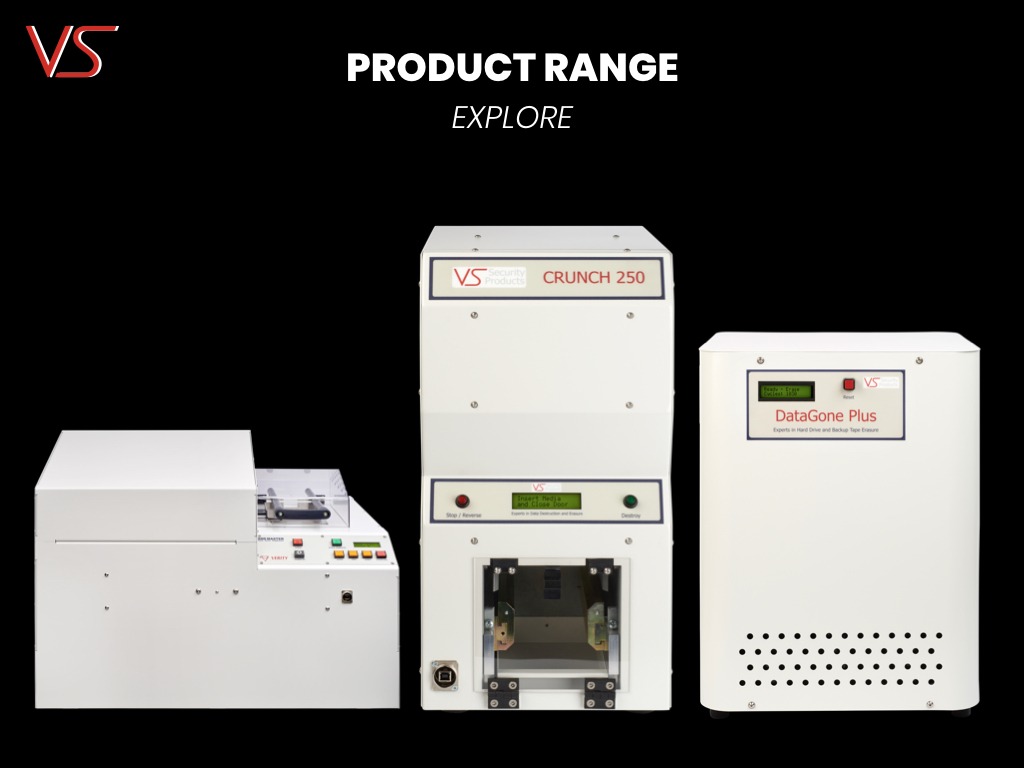
The first line of defense in destroying data on mechanical hard drives (HDDs) and magnetic tapes is degaussing. This process uses a powerful electromagnetic field to disrupt the magnetic alignment of the storage medium, rendering all data irretrievable. The NSA-listed SDD Master is a trusted solution for degaussing, ensuring complete erasure of HDDs and tapes in compliance with the most stringent security standards.
2. Crushing for Mechanical and Solid-State Drives
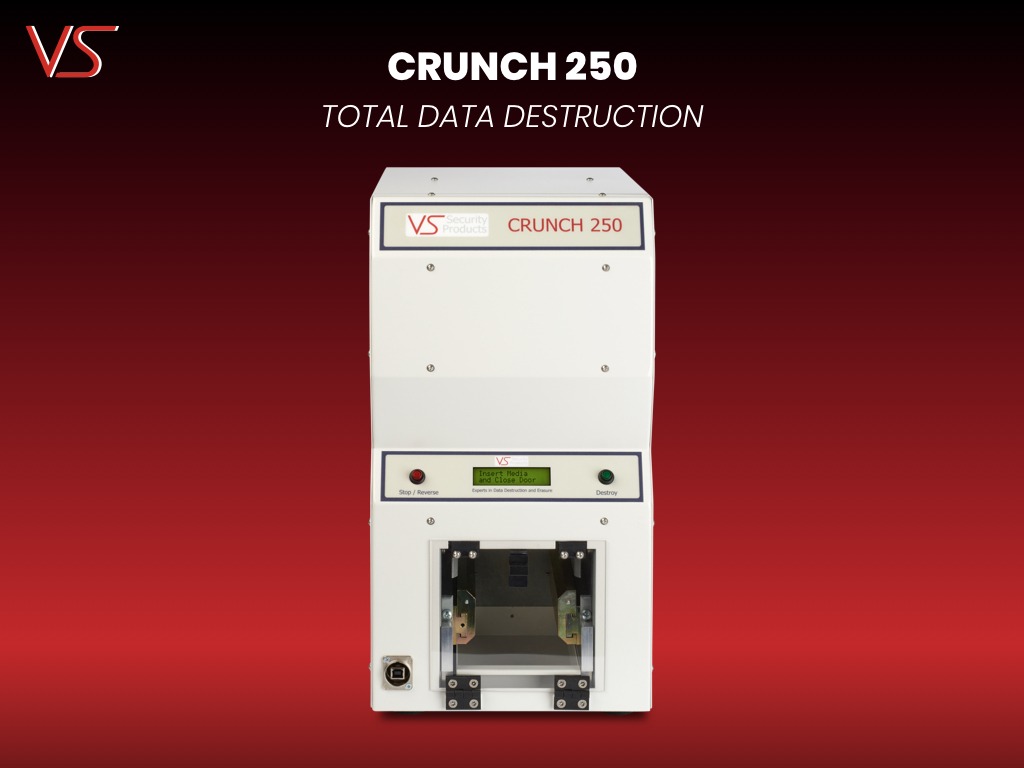
After degaussing, mechanical drives should undergo physical destruction. The NSA-listed Crunch 250 is designed to crush HDDs into small, unusable fragments, effectively neutralizing the hardware. For solid-state drives (SSDs), which cannot be degaussed, the Crunch 250 serves as the first step in their destruction by breaking them into smaller pieces.
3. Shredding SSD Fragments into Microparticles
SSDs and other flash media require an additional step to ensure complete destruction. The Mediagone 500 shredder reduces SSD fragments into microparticles, exceeding industry standards for secure data destruction. This two-step process — crushing followed by shredding — ensures that no data can be reconstructed.
4. Auditing and Verification
Comprehensive data destruction isn’t complete without verifiable proof. Using imaging devices and data destruction auditing software integrated with devices like the Crunch 250, SDD Master, and Mediagone 500 provides a digital record of each drive destroyed. The Data Destruction Auditor suite and DD Imager offer photo evidence, catalogued serial numbers, and detailed destruction metrics for compliance and record-keeping. This additional layer of accountability is crucial for organizations that must demonstrate adherence to strict regulatory requirements.
The Ultimate On-Site Data Destruction Solution
By combining degaussing, crushing, shredding, and auditing, organizations can create an unbreachable defense against data recovery. On-site deployment of devices like the SDD Master, Crunch 250, and Mediagone 500 offers businesses and government agencies complete control over the destruction process, eliminating the risks associated with transporting sensitive data to third-party facilities. Furthermore, the capability to perform all destruction steps in-house reinforces confidence in the security of retired storage devices.
Military-Grade Data Destruction in 2025
Military-grade data destruction protocols provide organizations with the highest level of security against sophisticated data recovery attempts, including those powered by AI. By incorporating degaussing, physical destruction, and shredding into their data governance frameworks, businesses can ensure that their sensitive information remains protected, even in the face of emerging threats. With solutions like the SDD Master, Crunch 250, and Mediagone 500, combined with robust auditing tools, organizations can establish secure, compliant, and reliable data destruction practices on-site.
In an era where data security directly correlates with organizational resilience, investing in comprehensive destruction protocols is not just advisable — it’s essential.
If you are looking for the highest level of data erasure for your organization, contact us today: [email protected]
Photo credit: Sharefaith